Every code tool reads your code. PulseRepo reads how your team works on it.
It turns your git history into plain-language questions about the work - who owns what, what's stuck, whether tests keep up - written for the people accountable for the code, not the ones writing it.
No signup, nothing stored but the report.
Your tracker says what was planned. PulseRepo reads what actually shipped - straight from the code and its git history.
#412 #418 #421 · 0 changes under tests/billing/refactor/payments · +2,140 / −1,870 · 1 reviewerThey read the code. We read the work.
Sourcegraph, Sonar, RepoLens and the rest inspect the code itself - for developers, to find what to fix. PulseRepo works one level up: it reads the process the history reveals, for the people accountable for the result.
Code tools parse syntax, structure and bugs. PulseRepo reads authorship, review flow, churn and whether tests move with features - the behavior a repo records, not the source it stores.
Search and quality tools are built for engineers. PulseRepo is built for the owner, CEO, investor or client who is accountable for the code but doesn't read it.
No score, no ranking, no issue backlog - just a short, ranked list of what's worth asking, each one backed by the exact commits and PRs behind it.
Jira can drift. The standup can drift. The code can't.
Every tracker, wiki, dashboard and status update is a second-hand account of the work - and each can quietly diverge from what really happened. The repository is the primary source of truth about a project: the literal record of what was built, by whom, and when.
Commits, authorship, review flow, churn and test changes - read directly. When the tracker and the tree disagree, the tree is what actually shipped. That's the record PulseRepo turns into questions.
Signals you can trust, framed as conversations
One read of your repository, turned into the few questions actually worth raising.


Questions, not verdicts
Every pulse is a short list of things worth asking in your next standup - never a score, a ranking, or a judgment of people.

Deterministic core
Same repo, same window, same answer. Reproducible signals you can trust - with AI layered on top, never underneath.

The whole story, windowed
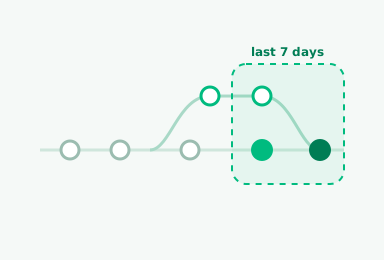
Commits, PRs, review latency, churn and semantic diffs - scoped to this sprint or since the last release, not all-time noise.

Tuned to the reader
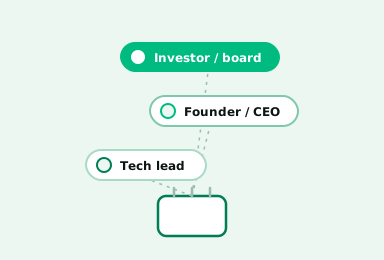
A tech lead, a CEO and an investor care about different altitudes. PulseRepo frames the same repo for each of them.

Multi-repo & trends
Track several repositories side by side and watch the trend line move week over week - not all-time noise.

Read-only, your data
Read-only access, tenant-isolated, with analysis cached so you never re-pay to analyze the same commit twice.
One repository, read at every altitude
The work is the same. The question that matters depends on who's asking.
From repo to questions in three steps
Most teams get their first pulse in a few minutes. Nothing to install.
Connect a repository
Sign in with GitHub or GitLab and pick a repo. Access is read-only - PulseRepo never writes to your code.
Choose a window
Last sprint, since the last release, or the past 30 days. PulseRepo reads only what happened in that period.
Get the questions
A ranked, plain-language list of what's worth asking - each one backed by the exact commits and PRs behind it.
Start free. Grow when it earns its keep.
The deterministic core is free forever. Paid tiers add AI signals, history and scale.
- 1 repository
- 5 pulse reports / month
- Deterministic signals
- Last-30-days window
- Up to 10 repositories
- 100 pulse reports / month
- AI work-items & demo-risk
- PR & review-flow questions (GitHub/GitLab)
- History & trends
- Client-ready report export
- Custom windows
* No credit card required.
- Unlimited repositories & reports
- Ask the repository - free-form Q&A
- Custom limits & bespoke features
- Self-hosted or open-source CLI
- Bring your own model keys
- SSO & priority support
Questions, answered
The honest version - especially the one about surveillance.
Is this developer surveillance?
No - and it's a deliberate design choice. PulseRepo never ranks people or scores individuals. The output is questions about the work and the process, written for the person reading them. If a metric could be used to grade a developer, it isn't here.
Do you store my source code?
Access is read-only and analysis runs on the git history, not a permanent copy of your repo. We cache the derived signals - not your source - and that cache is isolated per tenant so you never re-pay to analyze the same commit twice.
Does it need AI to be useful?
No. The deterministic core runs entirely without a model and produces reproducible signals on its own. AI is an optional layer for richer work-item and demo-risk detection.
What does it connect to?
GitHub and GitLab today, via OAuth with read-only scope. More sources are on the roadmap.
Who is a pulse actually written for?
Whoever's reading it. A tech lead gets release-risk questions; a founder gets roadmap-alignment questions; an investor gets process-health questions. Same repository, framed for the altitude that matters to you.
Why read the code instead of our project tracker?
Because trackers, wikis, dashboards and standup updates are all second-hand accounts of the work - and any of them can quietly drift from what really happened. The repository is the primary source: the literal record of what was built, by whom, and when. When the tracker and the code disagree, the code is what shipped. PulseRepo reads that record directly, so its questions are grounded in fact, not status fields.
Know what to ask before the standup.
Connect a repo and read your first pulse in minutes - free, read-only, no card.
Start free